 Flashcards
Social Psychology Flashcards
View Flashcards → Download as-is, or customize
to fit your needs.
About:
This 108-card flashcard set covers core social psychology topics including attribution theory, conformity (Sherif, Asch, Milgram), prejudice and stereotyping, aggression, and prosocial behavior. It includes key theories, classic experiments, and concept questions drawn from chapters 40–43. Use it for exam preparation, comprehensive review, or self-study in an introductory or intermediate social psychology course.
Terms in This Set
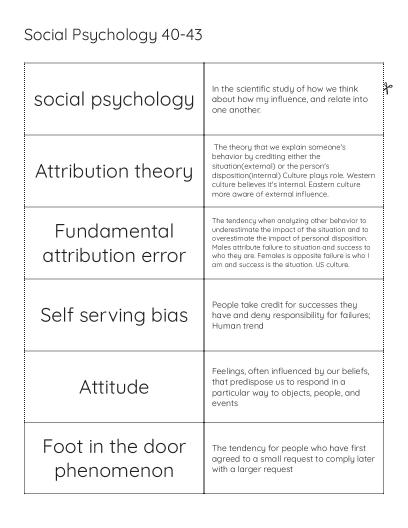
- social psychology
- Attribution theory
- Fundamental attribution error
- Self serving bias
- Attitude
- Foot in the door phenomenon
- Role
- Cognitive dissonance theory
- Peripheral route persuasion
- Central route persuasion
- What do social psychologists study? how do we tend to explain others behavior and our own?
- How do attitudes and actions interact?
- How do peripheral route persuasion and central route persuasion differ?
- How can we share our views more effectively?
- A study indicated that most teen boys and girls believe the women they see on online **** are experiencing real sexual pleasure. But the situation being in front of the camera suggests the women are acting their role. Social psychologists might explain the teens misperception as the blank blank error
- We tend to agree to a larger request more readily if we have already agreed to a small request. This tenancy is called the ____-____-___-____ phenomenon
- Chamala's therapist has suggested that Jamala should act as if she's confident, even though she feels insecure and shy. Which social psychological theory would best support this suggestion and what might the therapist be hoping to achieve?
- Celebrity endorsements and advertising often lead consumers to purchase products through______(Central/peripheral) Route persuasion
- Norms
- Conformity
- Normative social influence
- Informational social influence
- Sherif’s Experiment
- Asch’s Experiment(Normative influence)
- Stanley Milgram's research on obedience- What was the study?
- What did Stanley Milgram's research on obedience do in the study (WWII Newspaper ad)
- Social facilitation
- Social loafing
- Deindividualization
- Group polarization
- Groupthink
- How is Social Contagion a form of conformity, and how do conformity experiments Reveal the power of social influence?
- What did Milgram's obedience experiments teach us about the power of social influence?
- What do the social influence studies teach us about ourselves? How much power do we have as individuals?
- How does the presence of others influence our actions, via social facilitation, social loafing, and Deviduation?
- How can group interaction enable group polarization?
- What role does the Internet play in Group polarization?
- How can group interaction enable group think?
- Researchers have found that a person is more likely to conform to a group if A the group members have diverse opinions. B The person feels competent and secure. C The person admires the group's status. D no one else will observe the person's behavior
- in milgram's experiments, the rate of obedience was highest when A the learner was at a distance from the teacher. B the learner was close at hand. C other teachers refused to go along with the experimenter. D the teacher just liked the learner.
- Dr Huang a popular music professor, delivers fascinating lectures on music history but gets nervous and makes mistakes when describing exam statistics in front of the class. Why does perf his performance vary by task?
- In a group situation that fosters arousal and anonymity, a person sometimes loses self consciousness and self control. This phenomenon is called
- Sharing our opinions with like minded others tends to strengthen our views, a phenomenon referred to as_______ _______
- Prejudice
- Stereotype
- Discrimination
- What is Kenneth Clarke's theory on insecurity prejudice and discrimination?
- Just world phenomenon
- in Group
- Out group
- in Group bias
- Scapegoat theory
- Social categorization
- Sexism
- Muzafer Sherif Robbers Cave experiment and contact hypothesis?
- Elliot Aronson
- Other race effect
- aggression
- Aggression Individual differences
- Frustration Aggression Principle
- Social script
- What is prejudice, how do explicit and implicit prejudice differ?
- What groups are frequent targets of prejudice?
- What are some social, emotional, and cognitive roots of prejudice, and what are some ways to reduce prejudice?
- How does psychology's definition of aggression differ from everyday usage? What biological factors make us more prone to hurt one another?
- What psychological and cultural factors may trigger aggressive behavior?
- Prejudice toward a group involves negative feelings, a tendency to discriminate, and overly generalized beliefs referred to as___________
- If several well publicized murders are committed by members of a particular group, we may tend to react with fear and suspicion toward all members of that group. In other words, we a Blame the victim. B overgeneralize from vivid, memorable cases. C view the world as just D rationalize inequality
- The other race effect occurs when we assume that other groups are________(more/less) Homogeneous than our own group
- Evidence of a biochemical influence on aggression is the finding that A aggressive behavior varies widely from culture to culture. B animals can be bred for aggressiveness. C Stimulation of an area of the brain's limbic system produces aggressive behavior. D A higher than average level of the hormone testosterone is associated with violent behavior in males.
- Studies show that the appearance of delinquent young people tend to use physical force to enforce discipline. This suggests that aggression can be A Learn through direct rewards B triggered by exposure to violent media C learn through observation of aggressive models or D caused by Hormone changes in puberty.
- A conference of social scientists studying the effects of pornography unanimously agreed that the violent porn a Has little effect on most viewers. B is the primary cause of reported and unreported rapes. C leads viewers to be more accepting of coercion in sexual relations. D has no effect, other than short term arousal and entertainment.
- Heterosexual pornography most directly influences men's aggression toward women when the following is true a Viewing time is lengthy. B Eroticism is portrayed. C sexual violence is portrayed. D the actors are attractive
- Mere exposure effect
- Passionate love
- Compassionate love
- Equity
- Self disclosure
- People tend to marry someone who lives or works nearby. This is an example of the ________________ _______ _______ in action
- How does being physically attractive influence others perceptions
- Altruism
- Bystander effect
- How does the two factor theory of emotion help explain passionate love?
- Two vital components for maintaining compassionate love are______________-and __________-_________
- Reciprocal altruism
- C.Daniel Batson’s 4 forces are? (why people do)
- Bystander intervention - In crisis or emergency situation (audience) what will bystanders do?
- Study on a speech class with 25 kids writing a five minute speech about helping others. What was that study about?
- Who is Kitty Genovese and what happened to her on March 13th 1964?
- Diffusion of responsibility
- social exchange theory
- Reciprocity norm
- Social responsibility norm
- conflict
- social Trap
- Mirror image perceptions
- Self fulfilling prophecy
- Superordinate goals
- What social psychology principle did the Kitty Genovese incident illustrate?
- Why do sports fans tend to feel a sense of satisfaction when their archival team loses question marks do such feelings in other settings make conflict resolution more challenging?
- What are some ways to reconcile conflicts and promote peace?
- G.R.I.T.
- Why do we befriend or fall in love with some people but not others?
- How does romantic love typically change as time passes?
- What is altruism? When are people most and least likely to help?
- How does social exchange theory and social norms explain helping behavior?
- How do social traps and mirror image perceptions fuel social conflict?
- What can we do to promote peace?
How to Use This Flashcard Set
Print these flashcards for study sessions, test prep, or self-paced review. Click 'Open These Flashcards' to edit terms, add images, or change the layout before printing.