 Flashcards
Psychotherapy and Biomedical Treatment Flashcards
View Flashcards → Download as-is, or customize
to fit your needs.
About:
This 83-card flashcard set covers major approaches to treating mental illness for college and adult learners. It includes psychoanalysis, humanistic therapy, behavior therapy, cognitive behavioral therapy (CBT), drug therapies, electroconvulsive therapy, and transcranial magnetic stimulation. Use it for psychology exam preparation, concept review, or self-study of treatment modalities and therapeutic effectiveness research.
Terms in This Set
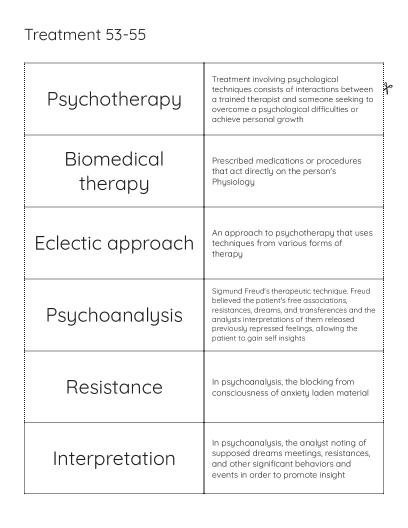
- Psychotherapy
- Biomedical therapy
- Eclectic approach
- Psychoanalysis
- Resistance
- Interpretation
- Transference
- Psychodynamic therapy
- Insight Therapies
- Person Centered Therapy
- Active listening
- Unconditional positive regard
- Behavior therapy
- Counter conditioning
- Exposure therapies
- Systematic desensitization
- Virtual Reality exposure therapy
- Aversive conditioning
- Token economy
- Cognitive therapy
- Cognitive Behavioral Therapy CBT
- Group therapy
- Family therapy
- psychodynamic therapy
- Person Centered Therapy
- Behavior therapy
- Cognitive therapy
- Cognitive behavioral therapy
- Group and family therapy
- How do psychotherapy and the biomedical therapies differ?
- What are the goals and techniques of psychoanalysis, and how have they been adapted in psychodynamic therapy?
- What are the basic themes of humanistic therapy? What are the goals and techniques of Rogers a person centered approach?
- How does the basic assumption of behavior therapy differ from the assumptions of psychodynamic and humanistic therapies? What classical conditioning techniques are used in exposure therapies and aversive conditioning?
- What is the main premise of therapy based on operant conditioning principles, and what are the views of its proponents and critics?
- What are the goals and techniques of the cognitive therapies and of cognitive behavioral therapy?
- What are the aims and benefits of Group and family therapies?
- Psychotherapy
- Confirmation bias
- Meta analysis
- Evidence based practice
- Therapeutic Alliance
- Does psychotherapy work? How can we know?
- Are some psychotherapies more effective than others for specific disorders?
- What three elements are shared by all forms of psychotherapy?
- What personal factors influence the client therapist relationship?
- When should a person seek therapy and And what should people look for when selecting a therapist?
- ` What ethical principles guide psychotherapy and psychological research on mental illness?
- How might the placebo affect bias clients and clinicians appraisals of the effectiveness of psychotherapies?
- Therapy is most likely to be helpful for those with problems that_______(Are/Are not) Well defined
- What is Evidence Based practice?
- There are many acceptable mental health treatment and study approaches, but all therapists and psychological researchers must follow____________ Principles
- The most enthusiastic or optimistic view of the effectiveness of psychotherapy comes from A outcome research B randomized clinical trials C reports of clinicians and clients DA government study of treatment for depression
- Studies show that_________ Therapy is the most effective treatment for most psychological disorders A behavior B humanistic C psychodynamic or D no type of
- What are the three components of evidence based practice?
- Psychotherapies help people by providing__________, A new perspective, and an empathetic, trusting, caring relationship
- Psychopharmacology
- Antipsychotic drugs
- Anti anxiety drugs
- Antidepressant drugs
- Electromagnetic therapy
- Transcranial magnetic stimulation (TMS)
- Psychosurgery
- Lobotomy
- A therapeutic lifestyle change therapy
- Drug therapies
- Brain stimulation
- Psycho surgery
- What are some examples of lifestyle changes people can make to enhance their mental health?
- How do researchers determine if particular drug therapies are effective?
- the drugs given most often to treat depression are called_________. Schizophrenia is often treated with__________.
- Severe depression that has not responded to other therapy may be treated with__________ ___________, Which caused some memory loss of the preceding hours. More moderate neural stimulation techniques designed to help alleviate depression include________ Direct current stimulation,______ Magnetic stimulation, and_________ Stimulation.
- What is the difference between preventive mental health and the psychological or biomedical therapies?
- Resilience
- Post traumatic growth
- Why is therapeutic lifestyle change considered an effective biomedical therapy, and how does it work?
- What other drug therapies, how do double blind studies help researchers evaluate a drug's effectiveness?
- How are brain stimulation and psychosurgery used in treating specific disorders?
- What may help prevent psychological disorders, and why is it important to develop resilience?
- Some antipsychotic drugs used to calm people with schizophrenia, can have unpleasant side effects, most notably a hyperactivity B momentary memory loss C sluggishness, tremors, and twitches. D paranoia
- Drugs such as Xanax, Ativan, which depress central nervous system activity, can become addictive when used as ongoing treatment. These are referred to as_______________ drugs.
- A simple salt that often brings relief to patients suffering the highs and lows of a bipolar disorder is_________
- When drug therapies have not been effective, electroconvulsive therapy ECT may be used as a treatment for people with a severe obsessive compulsive disorder B severe depression C schizophrenia D anxiety disorders
- An approach that seeks to identify and alleviate conditions that put people at higher risk for developing psychological disorders is called a deep brain stimulation B the mood stabilizing perspective C spontaneous recovery or D preventative mental health
How to Use This Flashcard Set
Print these flashcards for study sessions, test prep, or self-paced review. Click 'Open These Flashcards' to edit terms, add images, or change the layout before printing.