 Flashcards
Motivation Theory Flashcards
View Flashcards → Download as-is, or customize
to fit your needs.
About:
This 98-card flashcard set covers motivation theory for college-level psychology students. It includes foundational concepts like drive-reduction theory, Maslow's hierarchy of needs, and the Yerkes-Dodson law, plus detailed coverage of hunger physiology (glucose, leptin, ghrelin), sexual response cycles, and social motivations like affiliation and achievement. Use it for exam preparation, concept review, or self-study in introductory or general psychology courses.
Terms in This Set
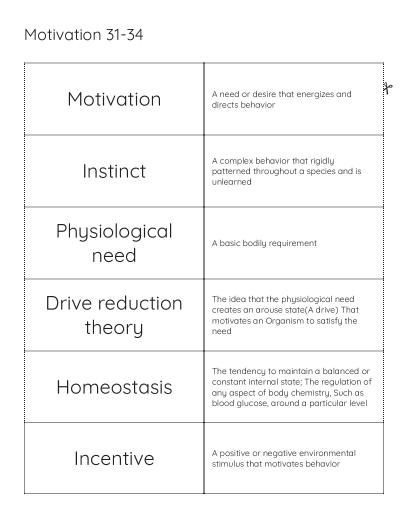
- Motivation
- Instinct
- Physiological need
- Drive reduction theory
- Homeostasis
- Incentive
- Yerkes-Dodson law
- Hierarchy of needs
- What the hierarchy of needs in Abraham Maslow's Pyramid (bottom first)
- Instincts and Evolutionary theory
- Drive reduction theory
- Arousal theory
- Maslow's Hierarchy of Needs
- Functions of motivation(5)
- 4 key motivation theories
- Today's evolutionary psychology shares an idea that was an underlying assumption of instinct theory. This idea is that a. Physiological needs arouse psychological states. b. Jeans predispose species typical behavior. c. Physiological needs increase arousal. d. External needs energized direct behavior
- An example of a physiological need is_____. An example of a psychological drive is_____. a. Hunger; a push to find food. b. I pushed to find food; Hunger. c. Curiosity; A push to reduce arousal. d. A push to reduce arousal; Curiosity
- Danielle walks into a friend's kitchen, smells cookies baking, and begins to feel very hungry. The smell of baking cookies is a(n) ____ (incentive/Drive)
- ____ theory attempts to explain behaviors that do NOT Reduce physiological needs.
- With a challenging task, Such as taking a difficult exam, performance is likely to peak when arousal is a. Very high b. Moderate c. Very low d. Absent
- According to Maslow's Hierarchy of Needs our most basic needs are physiological, including the need for food and water; Just above these are_______ needs. a. Safety b. Self esteem c. Belongingness d. Self transcendence.
- Glucose
- Set point
- Basal metabolic rate
- Lateral hypothalamus (LH)
- Ventromedial hypothalamus VMH (The satiety center)
- ghrelin
- Orexin
- Leptin
- PYY
- What psychological factors produce hunger
- What cultural and situational factors influence hunger?
- How does obesity affect physical and psychological health? What factors are involved in weight management?
- Journalist Dorothy Dix once remarked, nobody wants to kiss when they are hungry. Which motivation theory best supports her statement?
- According to the concept of____ Point Our body maintains itself at a particular weight level
- Which of the following is a genetically predisposed response to food? a. An inversion to eating cats and dogs. b An interest in novel foods. c. A preference for sweet and salty foods. d. An aversion to carbohydrates
- Blood sugar provides the body with energy. When it is_____( Low/high), we feel hungry
- The rate at which your body expends energy While at rest is referred to as the______ ____ rate
- Obese people often struggle to lose weight permanently. This is due to several factors, including the fact that a. Trying to lose weight triggers neophobia. b. The set point of obese people is lower than average. c. With food restriction, metabolism increases. d. There is a genetic influence on body weight
- Sanjay Eats a diet high in processed foods, fat, and sugar. He knows he may gain weight, but he figures it's no big deal because he can simply lose it in the future. How would you evaluate Sanjay's plan?
- Asexual
- Testosterone
- Estrogens
- sexual response cycle
- Refractory period
- Sexual dysfunction
- Erectile disorder
- Female orgasmic disorder
- Paraphilias
- AIDS Acquired Immune Deficiency Syndrome
- Sexual orientation
- How do hormones influence sexual motivation?
- What is the Human Sexual Response cycle, and how do sexual dysfunctions and paraphilias differ?
- How can sexually transmitted infections Be prevented?
- How do external and imagined stimuli contribute to sexual arousal?
- What factors influence teenagers sexual behaviors and use of contraceptives?
- How do we know about sexual orientation?
- What role do social factors play in our sexuality?
- Masters and Johnson's Research conclusions
- *Sexual response cycle: Excitement
- ** Sexual response cycle: Plateau
- ** Sexual response cycle: Orgasm
- ** Sexual response cycle: Resolution
- refractory period
- sexual dysfunction
- Erectile disorder
- female orgasmic disorder
- Paraphillas
- AIDS acquired immune deficiency syndrome
- Sexual orientation
- How do Ramos influence human sexual motivation?
- What is the human's sexual response cycle and how do sexual dysfunctions and paraphilias differ
- How can sexually transmitted infections be prevented?
- Alfred Kinsey
- date rape
- sexually explicit material research
- Simon Lee Valley Research (1991)
- Hormone derived sexual scent research (2005)
- Glucose
- Set point
- Basal metabolic rate
- Obesity
- How the hormones influence human sexual Motivation
- What is the human sector cycle and how does central dysfunctions and paraphrases differ?
- Affiliation need
- self determination theory
- ostracism
- Narcissism
- Achievement motivation
- Grit
- Intrinsic motivation
- Extrinsic motivation
- What evidence points to our human affiliation need - our need to belong?
- How does social networking influence US?
- What is achievement motivation and what are some ways to encourage achievement?
- Which of the following is NOT evidence supporting the view that humans are strongly motivated by a need to belong? A student who rated themselves as very happy also tended to have satisfying close relationships. B. social exclusion such as exile or solitary confinement is considered a severe form of punishment C. as adults adopted children tend to resemble their biological parents D children who are extremely neglected become withdrawn frightened and sometimes even speechless
- What are some ways to manage our social networking time successfully?
- If we want to increase our chance of success in achieving a new goal, such as stopping smoking, we ________ should/ should not Announce the goal publicly, and we ________ should/should not share with others our progress towards achieving that goal.
How to Use This Flashcard Set
Print these flashcards for study sessions, test prep, or self-paced review. Click 'Open These Flashcards' to edit terms, add images, or change the layout before printing.