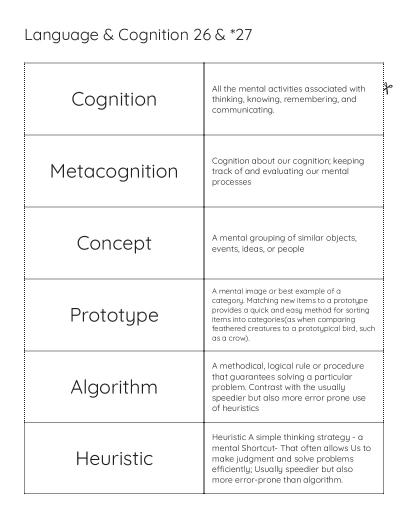
 Flashcards
Language and Cognition Flashcards
View Flashcards → Download as-is, or customize
to fit your needs.
About:
This 58-card set covers cognitive and language development topics for college-level psychology or linguistics courses. It includes concepts like metacognition, heuristics, confirmation bias, language milestones (babbling, one-word, two-word stages), brain areas (Broca's and Wernicke's), and the relationship between language and thought. Use it for exam preparation, concept review, or self-study of psychological and linguistic principles.
Terms in This Set
- Cognition
- Metacognition
- Concept
- Prototype
- Algorithm
- Heuristic
- insight
- Confirmation Bias
- Fixation
- Mental set
- Intuition
- Representativeness heuristic
- Availability heuristic
- Overconfidence
- Believe perseverance
- Framing
- nudge
- Creativity
- convergent thinking
- Divergent thinking
- *language
- *Phenome
- *Morpheme
- *grammar
- *Babbling stage
- *One word stage
- *Two word stage
- *Telegraphic speech
- *Aphasia
- *Broca’s Area
- *Wernicke’s Area
- *Linguistic determinism
- *Linguistic relativism
- *What are the structural components of language?
- *How do we acquire language, and what is universal grammar?
- *What are the milestones in language development, and when is the critical. For acquiring language?
- *What brain areas are involved in language processing and speech?
- *What do we know about other species capacity for language?
- *What is the relationship between thinking and language, and what is the value of thinking in images?
- *Children reach the one word stage of development at about a. 4 months b. 6 months c. One year d. Two years
- *The three basic building blocks of language are
- *When young children speak in short phrases using mostly verbs and nouns, this is referred to as
- *According to Chomsky, humans have built in predisposition to learn grammar rules. He calls this trait
- *Most researchers agree that apes can a. Communicate through symbols. b. Reproduce most human speech sounds. c. Master language in adulthood. d. Surpass human 3 year old in language skills
- What are cognition and metacognition, and what are the functions of concepts?
- What cognitive strategies assist our problem solving, and what obstacles hinder it?
- What is intuition, and how can the representativeness and availability heuristics influence our decisions and judgments?
- What factors exaggerate our fear of unlikely events?
- How are our decisions and judgments affected by overconfidence, belief perseverance, and framing?
- How do smart thinkers use intuition?
- What is creativity and what fosters it?
- What do we know about thinking another species?
- A mental grouping of similar things is called a
- The most systematic procedure for solving a problem is an
- Oscar describes his political beliefs as strongly liberal, but he is interested in exploring opposing viewpoints. How might he be affected by confirmation bias and belief perseverance?
- A major obstacle to problem solving is fixation, which is an a. Tendency to base our judgments on vivid memories b. Tendency to wait for insight to occur c. Inability to view a problem from a new perspective d. A rule of thumb for judging the likelihood of an event in terms of our mental image of it
- Terrorist attacks made Americans more fearful of being victimized by terrorism than of other, greater threats. such Exaggerated fear after dramatic events illustrates the ____________ Heuristic
- In the early 20th century, some psychologists noted that the animal consciousness can be inferred from the their behavior. In the early 21st century, other scientists argued that animal consciousness can inferred from their brains__________________________ __________________
How to Use This Flashcard Set
Print these flashcards for study sessions, test prep, or self-paced review. Click 'Open These Flashcards' to edit terms, add images, or change the layout before printing.