 Flashcards
Intergroup Contact Theory and Social Division Flashcards
View Flashcards → Download as-is, or customize
to fit your needs.
About:
This five-card set explores intergroup contact theory and its role in reducing social division. Cards cover economic inequality and social trust, Allport's contact theory framework, practical limitations like self-segregation and negative contact, inclusive shared spaces, and evidence from Pettigrew and Tropp's research. Suitable for adult learners studying social psychology, community building, or understanding divisive social dynamics.
Terms in This Set
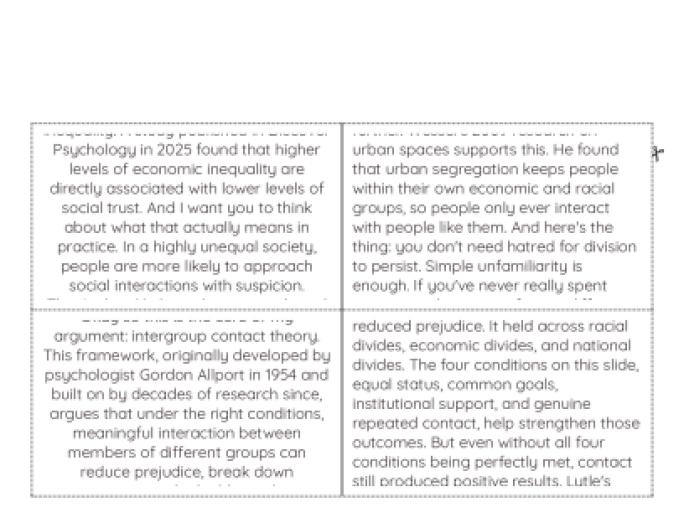
- My second argument is about a slower, less visible form of division: economic inequality. A study published in Discover Psychology in 2025 found that higher levels of economic inequality are directly associated with lower levels of social trust. And I want you to think about what that actually means in practice. In a highly unequal society, people are more likely to approach social interactions with suspicion. They're less likely to show up to shared spaces. They're more likely to withdraw into their own group.
- Okay so this is the core of my argument: intergroup contact theory. This framework, originally developed by psychologist Gordon Allport in 1954 and built on by decades of research since, argues that under the right conditions, meaningful interaction between members of different groups can reduce prejudice, break down stereotypes, and rebuild social trust.
- Now I want to be honest about the limitations here, because I think a strong argument has to acknowledge what it can't fully explain. The first limitation is self-segregation. Wessel's research shows that even in diverse neighborhoods, people tend to gravitate toward those most similar to them. Just putting diverse people in the same space doesn't guarantee they'll actually interact. The presence of diversity is necessary but not sufficient. Second, negative contact can actually make things worse. Lytle's research shows that if intergroup interactions are hostile or competitive, they can reinforce stereotypes rather than reduce them. So the quality and structure of the interaction really matters. You can't just force people together and expect positive results.
- So what does that actually look like in practice? I identified three main categories of solutions. The first is building more inclusive shared spaces, the kind of third places Ferreira et al. describe, that are accessible to people across economic backgrounds. Not just coffee shops that cater to one income level, but parks, community centers, libraries, and public spaces that draw a genuinely diverse crowd.
- So to bring it all back: division is real. The Berlin Wall was real. The isolation of COVID was real. The way inequality quietly keeps people apart is real. But so is the capacity for connection. Pettigrew and Tropp's 515 studies and 250,000 participants didn't find that connection was impossible. They found that when people are given genuine opportunities to interact across the lines that divide them, prejudice decreases, trust grows, and communities rebuild.
How to Use This Flashcard Set
Print these flashcards for study sessions, test prep, or self-paced review. Click 'Open These Flashcards' to edit terms, add images, or change the layout before printing.