 Flashcards
Intelligence: Theories and Testing Flashcards
View Flashcards → Download as-is, or customize
to fit your needs.
About:
This 70-card flashcard set covers intelligence theories and testing for college-level psychology study. It includes major frameworks such as Spearman's general intelligence, Gardner's multiple intelligences, and Sternberg's triarchic theory, along with testing methods (Stanford-Binet, WAIS), statistical concepts (reliability, validity, standardization), and research on heritability, stereotype threat, and environmental influences. Use it for exam preparation, concept review, or self-study in introductory or advanced psychology courses.
Terms in This Set
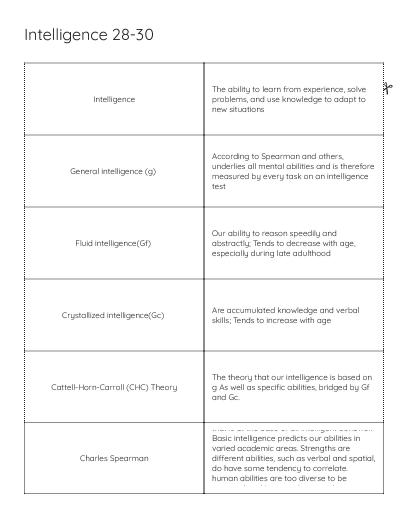
- Intelligence
- General intelligence (g)
- Fluid intelligence(Gf)
- Crystallized intelligence(Gc)
- Cattell-Horn-Carroll (CHC) Theory
- Charles Spearman
- Cattell-Horn-Carroll Theory
- Savant syndrome
- emotional intelligence
- Sternberg’s Three Intelligences
- Thurstone’s Primary Mental Abilities
- Cattell Horn-CArroll (CHC) Theory
- Gardeners multiple intelligences
- Sternbergs triarchic theory
- Emotional intelligence
- Intelligence test
- Achievement test
- Aptitude test
- Mental age
- Stanford-Binet
- Intelligence quotient(IQ)
- Wechsler Adult Intelligence Scale (WAIS)
- Standardization
- Normal curve
- Reliability
- Validity
- Predictive validity
- Cross sectional study
- Longitudinal study
- Cohort
- Heritability
- growth mind set
- Stereotype threat
- How do psychologists define intelligence?
- What are the arguments for g?
- How have the concepts of Gf & Gc & the CHC Theory , Affected our understanding of intelligence?
- How do gardeners and Sternberg's theories of multiple intelligences differ, and what criticisms have they faced?
- what are the four concepts of emotional intelligence?
- What is an intelligent test and how do Achievement and aptitude tests differ?
- What is a normal curve and what does it mean to say that a test has been standardized and is reliable and valid?
- What are the traits of those at the low and high intelligence extremes?
- What are cross sectional studies and longitudinal studies and why is it important to know which method was used?
- How stable are intelligence test scores over the lifespan?
- How does aging affect crystallized intelligence GC and fluid intelligence GF?
- Intelligence test
- Achievement Test
- Aptitude test
- Mental age
- Stanford Bennett
- Intelligence quotient
- Wechsler's Adult Intelligence Scale WIAS
- Standardization
- Normal curve
- Reliability
- Validity
- Predictive validity
- Cross sectional study
- Longitudinal study
- Cohort
- Heritability
- Growth mindset
- Stereotype threat
- What is heritability and what do twin and adoption studies tell us about the nurture and nature of intelligence?
- How can environmental influences affect cognitive development?
- How and why do the genders differ in mental ability scores?
- Our intelligence tests biased or unfair? What is stereotype threat, and how does it affect test takers performance?
- To say that the irritability of intelligence is about 50% means 50% of a. An individual's intelligence It is due to genetic factors. b. B the similarities between two groups of people are attributable to genes. c. The variation in intelligence within a group of people is attributed to genetic factors d An individual's intelligence is due to each parent's genes
- The strongest support for Heredity's influence on intelligence is finding that In identical twins, but not other siblings have nearly identical intelligence test scores b. The correlation between intelligence test scores of fraternal twins is not higher than that for other siblings c Similarity of mental abilities between adopted siblings increases with age d Children in impoverished families have similar intelligence scores
- The environmental influence that has the clearest, most profound effect on intellectual development is A exposing normal infants to enrich programs before age one. b. Growing up in an economically disadvantaged home. c. Being raised in conditions of extreme deprivation. d. Being an identical twin
- ____________ Can lead to poor performance on tests by undermining test takers belief that they can do well on the test
How to Use This Flashcard Set
Print these flashcards for study sessions, test prep, or self-paced review. Click 'Open These Flashcards' to edit terms, add images, or change the layout before printing.