 Flashcards
Evolution, Earth Science, and Astronomy Flashcards
View Flashcards → Download as-is, or customize
to fit your needs.
About:
This 91-card flashcard set covers major 8th Grade science topics including evolution and natural selection, fossil types and dating methods, geological time periods, Earth structure and processes, weather and climate systems, and astronomy. It includes key terms such as fitness, embryo, homologous structures, radioactive dating, greenhouse gases, and lunar phases. Use it for comprehensive science vocabulary review, unit exam preparation, or self-study across multiple earth and life science units.
Terms in This Set
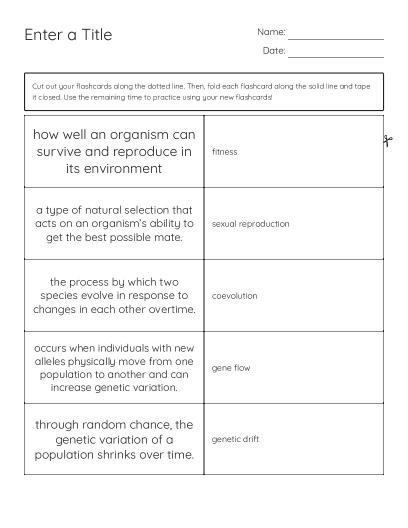
- how well an organism can survive and reproduce in its environment
- a type of natural selection that acts on an organism’s ability to get the best possible mate.
- the process by which two species evolve in response to changes in each other overtime.
- occurs when individuals with new alleles physically move from one population to another and can increase genetic variation.
- through random chance, the genetic variation of a population shrinks over time.
- all of the fossils that have been discovered and what we have learned from them.
- a young organism that develops from a fertilized egg.
- similar structures that related species have inherited from a common ancestor
- no longer exists and will never live again on earth.
- small solid pieces of material that come from rocks or the remains of organisms and settle to the body of a body of water.
- a solid copy of an organism shape containing some of the original organism.
- a hollow area in the rock that is the shape of an organism or part of an organism.
- fossils that an organism has left behind.
- building blocks of amino acids that carry out cellular functions.
- when one organism moves inside another organism’s cell.
- the last universal common ancestor and is a single-celled organism similar to modern bacteria.
- its age compared to the ago of another rock.
- the number of years that have passed since the rock has formed.
- the oldest layer is at the bottom, and the youngest is at the top.
- preserved remains or traces of living things.
- a gap in the geological record shows where rock layers have been lost due to erosion.
- the atoms of one element break down to form atoms of another element.
- determines the amount of radioactive elements in a rock; compare that with the stable element into which the radioactive element decays.
- rock layers that formed a record of Earth’s history of change.
- molten material between Earth’s surfaces.
- magma that reaches Earth’s surfaces
- a break in Earth’s crust
- a fossil of an organism that was widely distributed and existed for a geologically short period of time
- bend and turn in rock layers
- measures the time it takes for half of the radioactive atoms to decay.
- a record of all the geological events and the evolution of life forms as shown in the rock ad fossil records.
- one of the units of geological time
- when eras are divided
- animals without back bones
- animals with a backbone
- when life began, earth formed, prokaryotic organisms came to be
- many kinds of organisms evolved because of the Cambrian explosion and ancient life
- a supercontinent
- the age of reptiles, middle life
- our current era, many mammals evolved to live in different enviornments.
- an animal that lives part on land and part on water.
- organisms with scaly skin and lay eggs that have tough, leathery shells.
- a vertebrate that controls its own body temperature and feeds milk to its young.
- these consist of an electric field an da changing magnetic field.
- average amount of energy of energy of motion of each particle of a substance.
- gases in the atmosphere trap heat near a planets surface, while some escape into space
- the total energy of motion in particles of a substance.
- transfer of heat by the movement of a fluid.
- transfer of heat by electromagnetic waves
- transfer of heat between two substances that are in direct contact
- the horizontal movement of air from an area of high pressure to an area of low pressure.
- a local wind that blows from an ocean or lake
- the flow of air from land to a body of water.
- a curving path due to earth’s rotation
- bounds of high-speed winds that blow from west to east and affect weather greatly.
- patterns of wind moving around the globe.
- large stream of moving water ate the surface of the ocean driven by global winds
- climate event that occurs every two to seven years in the pacific ocean.
- when surface waters in the Eastern hemisphere are colder than normal.
- largest and most powerful surface in the north atlantic ocean.
- temperature and precipitation typical of an area over a long period.
- certain gases in the atmosphere that absorb much of the heat leaving Earth’s surface.
- sudden or gradual change in Earth’s climate.
- substances formed from remains of organisms
- unforseen chain of events caused by a disturbance in a system
- clean energy sources that don’t come from fossil fuels
- process by which greenhouse gases trap heat
- giant ball of super heated gas composed of hydrogen and helium
- object that orbits the sun large enough to become rounded by its own gravity and has cleared the area of its orbit of any debris.
- streak of light in the sky produced by the burning of a meteroid in Earth’s atmosphere.
- cold mixture of dust and ice that develops a long trail of light as it approaches the sun.
- pattern or group of stars that people imagine represent a figure, animal, or object.
- earth centered model
- sun centered model
- oval shape rotation
- imaginary line that passes through the north pole to earths center to the south pole.
- spinning of earth on its axis
- movement of one object around another
- earths path around the sun
- one day where sun appears highest in the sky
- when neither hemisphere is tilted towards the sun
- states that every object in the universe attracts every other object
- force that attracts all objects toward each other.
- tendency of an object to resist a change in motion.
- different shapes of the moon we see
- when an object in space comes between the sun and another object, cases a shadow on the other object.
- very darkest part of the shadow where the light from the sun is blocked.
- area of the shadow where the sun is partially blocked.
- rise and fall of the ocean water that occurs approximately every 12.5 hours and results from gravitational differences in how earth, sun, and the moon interact at different alignments
- most significant difference between consecutive high and low tides.
- the least significant difference between consecutive high and low tides.
How to Use This Flashcard Set
Print these flashcards for study sessions, test prep, or self-paced review. Click 'Open These Flashcards' to edit terms, add images, or change the layout before printing.