 Flashcards
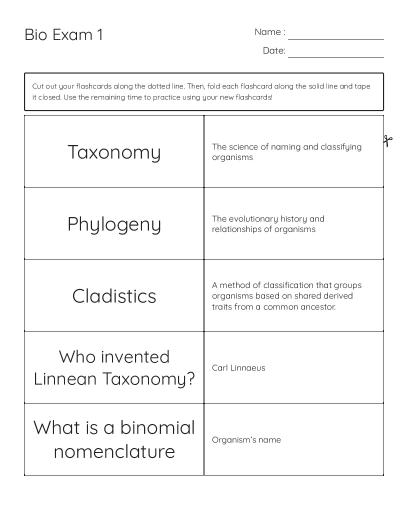
Biology Exam 1 Flashcards
View Flashcards → Download as-is, or customize
to fit your needs.
About:
This 78-card flashcard set covers the main topics in an introductory college biology course: taxonomy and phylogeny, bacterial and archaeal structure and function, eukaryotic cell origins via endosymbiosis, viral replication, protists, and fungi. It includes questions on Linnean nomenclature, the three domains of life, the lytic and lysogenic cycles, and key organisms like cyanobacteria and dinoflagellates. Ideal for exam preparation or self-study review.
Terms in This Set
- Taxonomy
- Phylogeny
- Cladistics
- Who invented Linnean Taxonomy?
- What is a binomial nomenclature
- How do you write out the name of a species?
- Why aren't common names good enough?
- What are the levels of classification
- What are the three domains of life?
- What are the four Eukaryotic Kingdoms
- What makes archaeans different from bacteria?
- How are archaeal cell membranes different from bacterial membranes?
- how are archaeal cell walls different from bacterial cell walls?
- What makes eukaryotes different from bacteria and archaeans
- What type of cells are bacteria and archaeans?
- What type of cells are Eukaryotes
- What are ancestral traits
- What are derived traits
- What are homologous traits
- What are analogous traits
- What is convergent evolution
- What kinds of characteristics are used to classify organisms?
- What is a molecular clock?
- What is a virus?
- Are viruses alive
- How do viruses reproduce?
- What is viral anatomy
- what is the lytic cycle?
- What is the lysogenic cycle?
- What is a bacteriophage
- What is a retrovirus
- what are prions made of
- How are prions transmitted?
- why do prions require special decontamination
- What structures do prokaryotes have?
- How do prokaryotes reproduce?
- What is conjugation?
- What is transformation
- What is transduction
- What are bacterial cell walls made of
- WHat does Hram staining tell you
- What are the three common bacterial shapes
- What is an aerobe
- What is an obligate anaerobe?
- What is a facultative anaerobe
- What is a photo autograph?
- What is a chemoheterotroph?
- What is commensalism
- What is paraitism
- What are bacterial endospores
- What are cyanobacteria
- Why is Pseudomonas syringe important?
- Why is Anabaena Azollae important
- Why is Bacillus subtillis important?
- Is kingdom protista monophyletic
- Are all protist unicellular
- What is endosymbiosis
- Which organelles came from endosymbiosis
- Why is Hatena are Nicola considered ongoing endosymbiosis
- Chlorophyta
- Rhodophyta
- Phaeophyta
- Diatoms
- Dinoflagellates
- Ciliates
- Amoebas
- Euglena
- Trypanosoma
- Why are algal blooms dangerous
- Vector vs hosts?
- What are fungi most closely related to
- What are fungal cell walls made of
- what are hyphae
- what is mycelium
- what is yeast
- What is budding
- What are lichens
- What are mycorrhizae
How to Use This Flashcard Set
Print these flashcards for study sessions, test prep, or self-paced review. Click 'Open These Flashcards' to edit terms, add images, or change the layout before printing.