 Bingo Cards
International Women's Day Bingo Cards
View Bingo Cards → Download as-is, or customize
to fit your needs.
About:
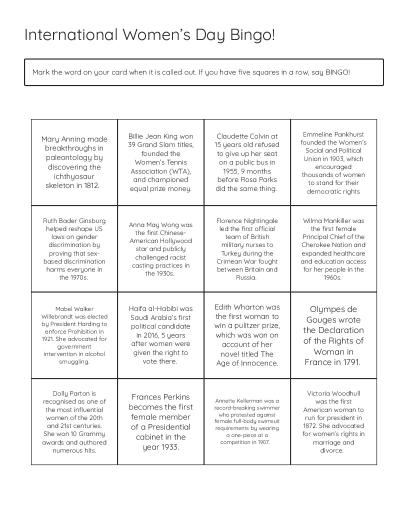
These 4×4 bingo cards celebrate 70 notable women whose achievements span science, activism, governance, and the arts. The list features pioneers like Katherine Johnson, Rosalind Franklin, and Sally Ride alongside civil rights leaders like Rosa Parks and Harriet Tubman. Use these for International Women's Day celebrations, history classes, or college-level discussions of gender equality and historical impact.
Word List
- Rosalind Franklin discovered the double helix structure of DNA because of her expertise in x-ray imaging in 1952, but received no credit in the Nobel Prize.
- Katherine Johnson was a NASA mathematician that calculated orbital trajectories and her math was responsible for bringing astronauts home alive in 1961.
- Mary Anning made breakthroughs in paleontology by discovering the ichthyosaur skeleton in 1812.
- Cecilia Payne-Gaposchkin was the first to prove that stars are made up of mostly hydrogen and helium in 1925.
- Alice Ball developed the first effective treatment for leprosy in 1915.
- Valentina Tereshkova was the first female astronaut on a solo mission in 1963.
- Ida B. Wells exposed lynching practices with statistics and helped found the NAACP in the 1900s.
- Shirley Chisholm was the first Black woman elected to Congress and ran for president in 1972.
- Dolores Huerta founded the United Farm Workers Union and negotiated labor contracts that improved conditions for thousands of farmers in 1955.
- Nellie Bly went undercover in a mental asylum in 1887 and exposed horrific abuse and created reforms.
- Wilma Mankiller was the first female Principal Chief of the Cherokee Nation and expanded healthcare and education access for her people in the 1960s.
- Anna May Wong was the first Chinese-American Hollywood star and publicly challenged racist casting practices in the 1930s.
- Ruth Bader Ginsburg helped reshape US laws on gender discrimination by proving that sex-based discrimination harms everyone in the 1970s.
- Gloria Steinem co-founded Ms. Magazine and helped mainstream second-wave feminism through the media in 1963.
- Funmilayo Ransome-Kuti led women’s protests against unfair colonial taxation in Nigeria in 1949 and laid foundations for the Nigerian independence movement.
- Huda Sha’arawi publicly removed her veil as a protest against gender discrimination in Egypt. In 1923, she founded the Egyptian Feminist Union to push for suffrage.
- Frida Kahlo used her portraits to challenge beauty standards and destigmatize disabilities in the 1940s.
- Olympes de Gouges wrote the Declaration of the Rights of Woman in France in 1791.
- Wangari Maathai mobilized rural women in Kenya in democratic reform and won the Nobel Peace Prize in 2004.
- Michelle Bachelet was the first female president of Chile and served as UN High Commissioner for Human Rights in 2018.
- In 1903, Emmeline Pankhurst founded the Women's Social and Political Union to campaign for women's suffrage.
- Ellen Johnson Sirleaf was the first female president of Liberia and is a Nobel Peace Laureate.
- Ada Lovelace was the first ever computer programmer.
- Florence Nightingale led the first official team of British military nurses to Turkey during the Crimean War fought between Britain and Russia.
- Lucile Ball revolutionized television as the first woman to run a major studio in 1962.
- Nell McCafferty was a journalist, activist, and founding member of the Irish Women's Liberation Movement who campaigned for reproductive health rights for Irish women.
- Dr. Tempil Grandin is a pioneering animal scientist and autism advocate. She redesigned the livestock industry with a humane handling system.
- Dolly Parton is recognised as one of the most influential women of the 20th and 21st centuries. She won 10 Grammy awards and authored numerous hits.
- Billie Jean King won 39 Grand Slam titles, founded the Women’s Tennis Association (WTA), and championed equal prize money.
- Helen Keller revolutionized the perception of people with disabilities, working with the American Foundation for the Blind and helping to improve treatment for the deaf and blind.
- Dr. Jane Goodall is one of the most influential women in conservation and animal welfare, known for revolutionizing primatology through her 1960s study of chimpanzees.
- Amelia Earhart pioneered aviation by becoming the first woman to cross the Atlantic and setting records. She founded the Ninety-Nines organization to support women in aviation.
- Sacagawea served as an interpreter and guide for the Lewis and Clark Expedition (1804–1806).
- Princess Diana modernized the English monarchy by pioneering HIV/AIDS awareness by reducing stigma, and campaigned globally against landmines.
- Harriet Tubman was a paramount American abolitionist, Underground Railroad conductor, and Civil War spy who freed hundreds of enslaved people.
- Simone Biles is the most decorated gymnast in history with 41 top-tier medals. She has reshaped conversations around mental health and abuse prevention.
- Oprah Winfrey is a media executive, talk show host and philanthropist, she broke barriers as the first Black female billionaire and reshaped modern media through her network.
- Sally Ride is recognized as a trailblazer for women in STEM and a national icon as the first American woman in space (1983).
- Hatshepsut was a female pharaoh during the 18th Dynasty, who reigned in Egypt for over two decades
- Marie Curie won two Nobel Prizes: the first for her work on radiation, the second for chemistry.
- Josephine Baker, a well-known performer and singer, sent messages to French soldiers in clever ways, such as hiding ink on her sheet music.
- Nellie Bly traveled across the globe in fewer than 80 days in 1889.
- The two best IQ test scores ever measured through standardized testing have been obtained by women.
- Rosa Parks greatly challenged racial segregation despite the consequences.
- Emmeline Pankhurst founded the Women’s Social and Political Union in 1903, which encouraged thousands of women to stand for their democratic rights
- Margaret Thatcher was Britain's first female prime minister.
- Cleopatra was the last ruler of Egypt’s Ptolemaic dynasty, who ruled despite various challenges.
- Elizabeth Fry made prison conditions more humane, while also improving the hospital system and treatment of the mentally ill.
- Vera Atkins was an intelligence officer who, after the war, tracked down and established how each of the 118 SOE agents missing died.
- Catherine the Great was the longest-ruling empress of Russia and supported art and education.
- Mary Shelley was the author of various famous works including the Modern Prometheus and Frankenstein, she also is the daughter of the famous Mary Wollstonecraft.
- Mother Teresa founded the Missionaries of Charity which invited many women to take vows of poverty. She had an affect in over 130 countries.
- Boudica was the queen of the Iceni tribe during the Roman occupation of Britain.
- Jane Austin is one of the most famous literary geniuses, exploring marriage and social status throughout her books.
- Mary Stopes was an advocate for birth control and sex education in the early 1900.
- Edith Wharton was the first woman to win a pulitzer prize, which was won on account of her novel titled The Age of Innocence.
- Frances Perkins becomes the first female member of a Presidential cabinet in the year 1933.
- Claudette Colvin at 15 years old refused to give up her seat on a public bus in 1955, 9 months before Rosa Parks did the same thing.
- Jeanette Rankin was the first woman in the United States Congress, elected in 1916.
- Annette Kellerman was a record-breaking swimmer who protested against female full-body swimsuit requirements by wearing a one-piece at a competition in 1907.
- Margaret Hamilton was a rocket scientist who led an MIT engineering division, assisting NASA with the scientific advancements necessary for the Apollo 11 mission in 1969.
- Haifa al-Habibi was Saudi Arabia’s first political candidate in 2016, 5 years after women were given the right to vote there.
- Victoria Woodhull was the first American woman to run for president in 1872. She advocated for women’s rights in marriage and divorce.
- Mabel Walker Willebrandt was elected by President Harding to enforce Prohibition in 1921. She advocated for government intervention in alcohol smuggling.
- Malala Yousafzai is a Pakistani advocate for girls’ education. At 15, she was shot by the Taliban for speaking up. She won the Nobel Peace Prize in 2014.
- Beyoncé is a global music icon, well-known for her inspiring lyrics promoting femininity while empowering people to take action against social injustice.
- Michelle Obama was the first Black First Lady of the United States. She advocates for gender equality in education and public welfare. She is a New York Times Bestselling author.
- Maya Angelou advocated for civil rights in the workforce during World War II. Her autobiography, I Know Why the Caged Bird Sings was awarded the Presidential Medal of Freedom.
- Elizabeth Cady Stanton was a women’s rights activist throughout the 1800s who helped organize the first gender equality conference in 1848, the Seneca Falls Convention.
- Queen Elizabeth promoted women’s rights through the Succession of the Crown Act, which stated that the oldest daughter has entitlement to the throne regardless of male siblings
How to Use This Bingo Cards
Print a class set of unique bingo cards for classroom games, review sessions, or parties. Click 'Open These Bingo Cards' to choose how many cards to generate and customize the word list.